
THE WORD YOU NEEDED ALL ALONG: YOU WEREN’T FAILING. YOU WERE GOING THROUGH MATRESCENCE.
[Written by Becca Aspin, Better Said Studio]
Beth is not who you’d expect. She’s got a degree in Psychology, works in construction, thinks in frameworks, and given half a chance will still be found on a dance floor at the end of the night. She has also spent five years building a map for one of the most complex transitions a woman will ever go through — and she believes, with complete conviction, that one word has the power to undo years of quietly believing you were the problem. Under a disco ball in Hull, she gave thirty women the word that changes everything.
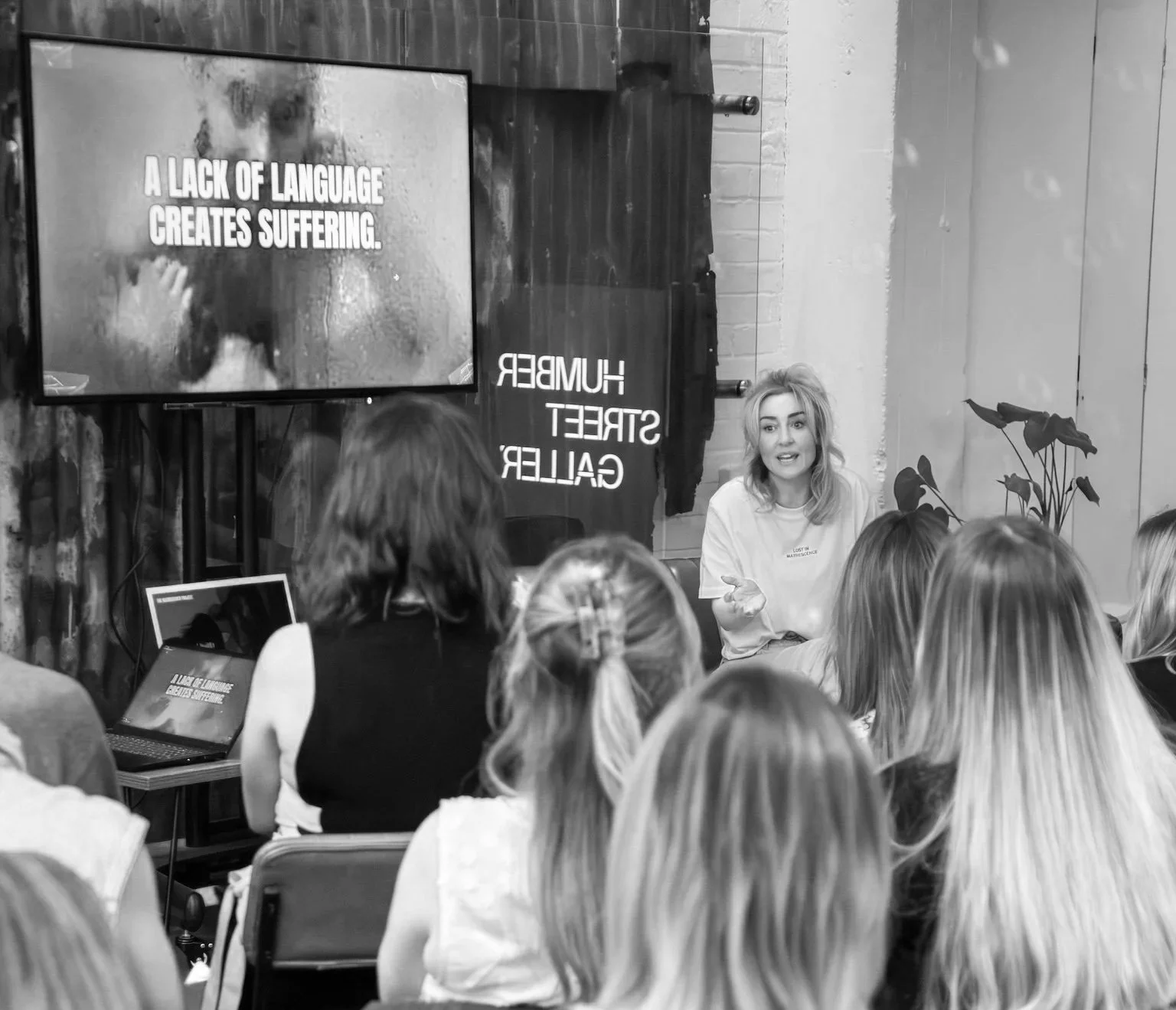
The venue tells you something. Humber Street Gallery in Hull — raw, industrial, unapologetically northern — is home tonight to Deadbod, the city’s most iconic artwork: a skeletal figure, arms wide, staring you down from the wall. Thirty women have gathered beneath it and beneath the spinning light of a disco ball, and there is something almost deliberately right about that. Beth under a disco ball is Beth in her element. She’s not here to be soft about this.
She takes the floor with the energy of someone who has been waiting — properly waiting, five years’ worth — for this moment. “I want to ask you something before we get into it,” she says. “Before tonight. Before you’d heard of matrescence. What did you actually believe happened to a woman when she became a mum?”
The room shifts slightly. You can almost hear the mental calculation happening — the honest answer versus the acceptable one.
“I think most of us just thought: it’s hard, but you adjust, don’t you? You figure it out. You crack on.” She looks around the room. “And that’s exactly the problem. Because we didn’t have a word for what was actually happening. So we didn’t think it deserved to be understood. And when you don’t think something deserves to be understood — you just internalise it. And you call it failure.”
“You can’t feel what you can’t name, and the world can’t see what you can’t name. So we minimise it. And then we make it mean something’s wrong with us.””
A FRIDAY NIGHT. A FRIEND’S HOUSE. THE WORD.
Beth knows the exact moment her life changed. She can tell you the date, the day of the week, even how it cross-references with the date she’s standing in this room. It was a Friday. The 23rd. She was at a friend’s house, stood against a door frame, trying to get her eldest daughter to sleep while everyone else was at dinner downstairs.
Both of them were crying.
“I was exhausted, I was furious with myself, and I was doing that thing you do — scrolling my phone just to be somewhere else in my head.” She pauses. “And I saw words that changed everything.”
What she’d experienced in the months before that moment was this: she’d had her daughter and immediately felt different. Quietly, privately, inexplicably different. She’d read everything. Done every class. Ticked every box. But somewhere between the night feeds and the weeks blurring together, she couldn’t locate herself anymore. “I remember staring out of the window at 2am, baby crying, and I could see a house opposite with the lights off. Normal people. Asleep. And I was quite jealous of that.” She’d started asking herself: when is life going to get back to normal? When is the old me coming back?
“If you’ve ever asked yourself that — it’s not ingratitude. It’s not weakness. It’s not failure.” She says this without softening it, without the gentle wrap of a therapist’s tone. It’s just a fact. “I didn’t know it then, but I was going through something enormous. And because I didn’t have a word for it, I thought something was wrong with me.”
The word she found on that phone screen was matrescence. The Monday after that Friday, she had the book on Amazon next-day delivery. She has spent every year since working out how to hand it to as many women as possible. This room, this Friday, this disco ball — this is five years in the making.
NOT MOTHERHOOD. BECOMING A MOTHER.
Here is where Beth's analytical brain kicks in — and where the framework she's built starts to matter. She draws a distinction that sounds almost too simple until it lands.
Motherhood, she explains, is the act of mothering. The feeding. The logistics. The relentless, practical business of keeping someone alive. Matrescence is something else entirely — and crucially, it’s not about the baby at all.
“Matrescence is about the mother,” she says, flatly. “It’s the developmental transition that happens to her.”
When you understand that becoming a mother is a transformation — not a task, not an adjustment, not something you should be able to get on top of — something cracks open. Because if it’s a transition, it has a shape. And if it has a shape, it can be mapped. And Beth has built exactly that.
“We treat a developmental transition like a personal shortcoming,” she says. “We think: I should be coping better. I should be bouncing back. I should be grateful.” Her voice stays level. No drama. Just the quiet precision of someone who has thought this through thoroughly. “And actually — becoming a mum is the best thing that ever happened to me. But the changes that came with it completely blindsided me. Because no one told me they were coming.”
She’d always resisted the framework idea at first, she admits. “I thought the solution had to look like meditation. Soundbaths. Something soft. Because that was what I’d seen in this space. And then I thought — there are two billion mothers in the world. Not all of them want to sit in a circle and do that work. Some of them just want to know what’s on the map.”
IN THE ROOM - THIRTY WOMEN SPEAK.
“I honestly didn’t think my life would change at all when I was pregnant. I was ready. Everything was planned. I was so naive. I kind of wish someone had just — told me.”
“Even when my kids were in primary school, I was still in it. Still lost. I’d assumed it was just the newborn bit. And then Beth said that — and I thought: oh. It’s still happening to me now.”
“Someone asked me what my values were. And I just said — I have absolutely no idea. I couldn’t even think. I’d been so focused on the baby, on work, on keeping everything going. I’d completely lost sight of me.”
“Do you think some of us were diagnosed with postnatal depression when actually it was matrescence? Because we didn’t have that word. We had nothing else to call it.”
YOUR BRAIN IS ACTUALLY BEING REWIRED.
This is not metaphor, and Beth is not interested in making it sound poetic. When you become a mother, your brain physically changes. The nervous system recalibrates. A heightened stress response switches on — that hyper-vigilance that makes you sit bolt upright at a sound no one else heard. Hormones shift with an intensity that most women are wholly unprepared for. And then they keep shifting, across the entire arc of matrescence.
“Everything is being reorganised,” she says. “Your emotions are redistributed. Your priorities shift. Your career, your friendships, your relationship with your own body, your sense of who you are in the world — nothing goes untouched.” And while all of that is happening, invisibly, internally: “Society is looking on going — why aren’t you coping better?”
The comparison to adolescence is deliberate. Both are major neurological transitions. Both reshape identity from the inside out. Both come with a body that feels unfamiliar and a self that is being rebuilt without warning. The difference is that adolescence has language, support structures, a whole cultural acknowledgement of its difficulty. Matrescence has — until now — had nothing. “Women were getting locked up for being menopausal,” one woman points out, “because no one understood it. And now — menopause, everyone knows about it. My husband knows more about it than I do. That’s where matrescence needs to get to.”
3 in 4 mothers experience mental health challenges during matrescence.
6 in 10 talk to themselves out of seeking help because they can’t name what they’re going through.
2 billion mothers in the world. Every single one going through matrescence. Not one exempt.
“A lack of language creates suffering,” Beth says, and there’s no flourish to it, no performance. Just the matter-of-fact delivery of someone who has sat with this truth for a long time. “When we don’t have the word, guilt fills that space. And it whispers.” She quotes Dr Gabor Mate. “Children aren’t traumatised by pain. They’re traumatised by being alone in it.” A beat. “I don’t think we’re traumatised by motherhood. I think we’re traumatised because we’re alone with the changes it brings. Naming matrescence doesn’t remove the hardness. It removes the aloneness.”
“Mothers at the minute are drowning in validation and starving for a solution. Everyone’s saying — God, it’s really tough. But what is it that can actually help?”
THE CONSULTANT WHO BUILT THE MAP.
This is where Beth’s background stops being incidental and becomes the whole point. She spent years learning to take complex, messy problems and give them structure. She can see a framework in anything. And when she looked at matrescence — this vast, invisible, under-named experience affecting every mother alive — her brain did what it always does.
It started drawing a map.
Eight territories. Four internal shifts, four in the outer world. The full landscape of what a woman moves through when she becomes a mother — charted, named, made navigable. “I drew it and I genuinely didn’t think it was any good,” she says, with a laugh. “I’d do talks, and at the end I’d go — oh, I’ve got this map, shall we do a meditation instead? Because that wasn’t what I’d seen in this space.” She shakes her head. “I wasted years on that.”
THE FULL LANDSCAPE OF BECOMING A MOTHER.
“I imagine a woman locating herself on this map and thinking — oh. I’m here. I get it. I can see where I am.” She pauses. “I imagine a manager looking at it before a woman comes back from maternity leave and finally understanding what she’s actually been going through. I imagine a partner being able to see it. To properly see it.”
In the room, the conversation opens up. A teenager coach draws the parallel with adolescence — brain rewiring, identity in flux, a world that barely acknowledges the enormity of it. An NHS worker describes coming back from maternity leave to a 13-hour night shift. “You just get on with it,” she says, flat as a stone. The room knows exactly what she means.
One woman stops everyone: “You’re in an echo chamber of other women who’ve also lost their intuition. You’re all sitting there questioning yourselves. And then matrescence is a circuit breaker. It goes — no. This makes sense. You haven’t lost who you are. This is just what’s happening.”
ON IDENTITY, BRAVERY & BECOMING.
“The word that keeps hitting me is becoming. I thought I’d have it figured out by now. But I’m starting all over again — learning who I am. And rather than grieving the woman I’ve lost, that feels exciting. Who is the woman I’m becoming?”
“As soon as I understood matrescence for what it was — I was fine. Quite quickly. I was like: right. I’m going through a transition. It’s got a name. I’m not going back to who I was. And I was okay with that. It doesn’t take much.””
“Davina McCall talks about menopause the way you talk about matrescence. She got everyone talking. She is the key person of influence for that conversation. You are that — already. Without even meaning to be.”
WHAT SHE WANTS FOR HER DAUGHTERS.
In a gallery in Hull, surrounded by thirty women who came in carrying something they couldn't name, Beth brings it back to where it started. To a friend’s house. To a door frame. To a Friday. To a woman who was not failing, not broken, not weak — who was going through something enormous, alone in it, with no word for it.
“I want to build a world where my daughters don’t have to discover matrescence the way I did,” she says. “I want them to already know. A word before they need it. A map before they feel lost.”
She wants it in every dictionary. In every workplace. In every conversation between a woman and her partner, her manager, her own mother, when things are hard and the language doesn’t exist yet to explain why. She wants it said out loud — not whispered, not hedged, not filed quietly away under too complicated, too niche, too much.
“Mums are incredible at getting on with it,” she says. “I genuinely believe that. But I also think the world has got very comfortable with that. Very comfortable with us mothering quietly. Not making a fuss. Not asking for things.” She doesn’t dress it up. “And when we do start talking about it — we start asking for what we need. And that gets tricky. But mums deserve to know what happens to them when they have a baby, and they deserve everyone around them to know it too”
She exhales. And thirty women know exactly what that exhale means - they all exhale with her.
Then she teaches the room to say the word — guides everyone through it together, out loud, under a disco ball, with a skeleton watching on — until the air is full of it.
MATRESCENCE. MATRESCENCE. MATRESCENCE.
“Say it,” she says. “Because people whisper it and I don’t know why. It’s just a word.” A beat. “But it’s the word that changes everything.”
